
Buyer’s Guide & Shop · Updated August 2026
HK CC9 Holsters: IWB & OWB Options In Stock
The CC9 is a brand-new micro-compact, which means most “universal” holsters on the market were never cut for it. This page covers every CC9-specific holster and magazine carrier we stock — 13 rigs across four makers — plus how to pick the right carry style, the right hand, and the right retention level the first time.
Start here: the 30-second pick
If you already know how you carry, skip the reading and jump straight to the rig. Every option below is in stock and ships from our warehouse.
Tuckable IWB. Shirt tucks over the gun. Ambidextrous shell.
Kydex IWB with adjustable retention. Right hand.
Leather OWB pancake. Rides tight and high. RH or LH.
Hard-use Kydex from a duty-gear maker. Right hand.
Why a CC9-specific holster matters
A holster is a piece of safety equipment before it is a convenience item. The single most important job it does is completely cover the trigger guard so nothing — a drawstring, a finger, a jacket toggle — can reach the trigger while the pistol is holstered. A holster cut for a different pistol cannot do that job reliably, no matter how close the outline looks.
The CC9 causes more fit problems than most new pistols for three specific reasons:
- It is genuinely slim. At roughly a 1-inch slide width, the CC9 sits in the narrowest tier of carry pistols. A shell molded for a double-stack 9mm will let it rattle, shift, and in the worst case tip out when you bend over.
- It has a direct-mount optics cut. If you are running a red dot, the holster has to clear the optic body. Many older shells were molded before optics-cut micro-compacts were common and will bind against the window or the rear of the sight.
- It has an accessory rail. A rail changes the dust-cover profile. Rigs molded for rail-less pistols often will not seat fully, which leaves the pistol sitting proud and unstable.
IWB vs OWB: which one you actually want
This is the decision that determines whether a holster gets worn or ends up in a drawer. It is less about preference than about what you wear and where you go.
Inside the waistband (IWB)
The holster sits between your body and your trousers. Only the grip is above the belt line, and a shirt covers it.
Choose IWB if: you carry concealed daily, wear an untucked shirt or a tucked shirt with a tuckable rig, and value staying unnoticed over speed.
Trade-offs: less comfortable against the body, slower to draw, and you typically need trousers one waist size up. Expect a genuine adjustment period.
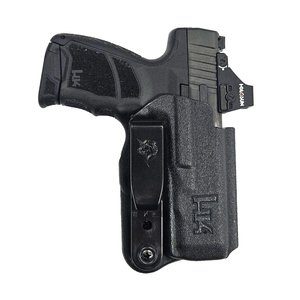
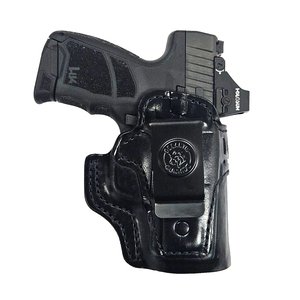
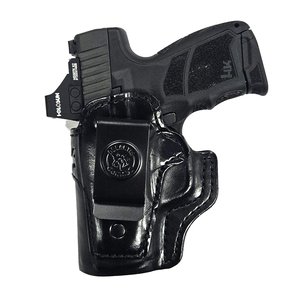
Good CC9 examples: DeSantis Slim-Tuk (tuckable), DeSantis Inside Heat (leather, softer against the body), ANR Design IWB (Kydex, adjustable retention).
Outside the waistband (OWB)
The holster rides on the belt outside your trousers. Faster, far more comfortable, and much easier to re-holster safely with one hand.
Choose OWB if: you are shooting at a range, carrying openly where legal, wearing a cover garment like a jacket or flannel, or you want a comfortable rig for long days.
Trade-offs: concealment depends entirely on your cover garment. A pancake-style OWB under an untucked flannel conceals well; the same rig under a fitted t-shirt does not.
Good CC9 examples: DeSantis Mini-Scabbard (leather pancake, RH and LH), ANR Design OWB (Kydex, RH and LH).
If you can only buy one: most people carrying the CC9 concealed are best served by a Kydex IWB with adjustable retention, because it covers the widest range of clothing. Buy the OWB second, once you know your carry position.
Right hand or left hand — do not guess
Roughly a third of returns on holsters come down to ordering the wrong hand. It is worth ten seconds of care.
The rule: the hand designation matches your dominant shooting hand, not the side of your body you prefer or your writing hand. If you shoot right-handed, you want RH — and that holster rides on your right hip.
Two things that trip people up:
- Cross-draw and appendix carry do not flip the designation. A right-handed shooter carrying appendix on the left side of the buckle still orders a right-hand holster.
- Ambidextrous is not the same as either-hand. The DeSantis Slim-Tuk uses an ambidextrous shell, which genuinely works for both. Most other rigs are hand-specific and cannot be converted.
Compare every CC9 holster we carry
All prices current as of August 2026. Confirm exact materials, retention hardware, and optic clearance on each product page before ordering.
| Holster | Type | Hand | Maker | Price | Best for |
|---|---|---|---|---|---|
| DeSantis CC9 Slim-Tuk | IWB | Ambi | DeSantis | $55.99 | Tucked shirts, deepest concealment, lowest price |
| DeSantis CC9 Inside Heat RH | IWB | Right | DeSantis | $65.99 | All-day comfort against skin |
| DeSantis CC9 Inside Heat LH | IWB | Left | DeSantis | $65.99 | All-day comfort, left-handed shooters |
| ANR Design CC9 IWB RH | IWB | Right | ANR Design | $69.99 | Everyday Kydex concealment |
| DeSantis CC9 Mini-Scabbard RH | OWB | Right | DeSantis | $83.99 | Leather pancake, tight to the body |
| DeSantis CC9 Mini-Scabbard LH | OWB | Left | DeSantis | $83.99 | Leather pancake, left-handed shooters |
| ANR Design CC9 OWB RH | OWB | Right | ANR Design | $86.99 | Range use, Kydex durability |
| ANR Design CC9 OWB LH | OWB | Left | ANR Design | $86.99 | Range use, left-handed shooters |
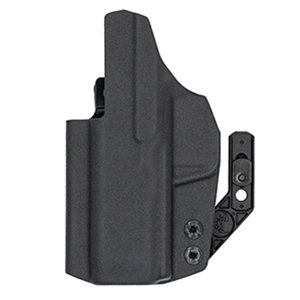
| Cipher Holster for CC9 | IWB | Right | Cipher | $108.00 | Low-profile concealment |
| G-Code Phenom Commando CC9 | OWB | Right | G-Code | $109.99 | Hard-use belt rig (out of stock) |
| G-Code Prime Carry CC9 | OWB | Right | G-Code | $124.99 | Everyday belt carry, premium build |
| G-Code Shadow Eclipse CC9 RH | Duty | Right | G-Code | $139.99 | Hardest use, highest retention |
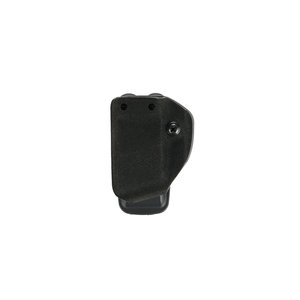
| G-Code GSM Single Mag Carrier | Mag | — | G-Code | $84.99 | One spare magazine |
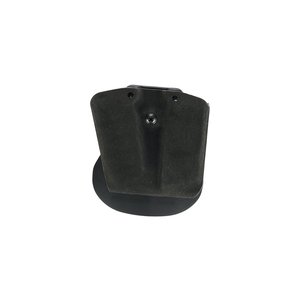
| G-Code GDM Double Mag Carrier | Mag | — | G-Code | $99.99 | Two spare magazines |
How to read the price spread: the $56–$70 tier gets you a correctly molded, safe, functional holster — the DeSantis Slim-Tuk is a legitimately good rig, not a compromise. The $85–$140 tier buys hardware quality: better clips, more adjustment, thicker material, and mounting systems that survive years of hard use. If you are buying your first CC9 holster and are not sure how you want to carry, start in the lower tier and spend the difference once you know.
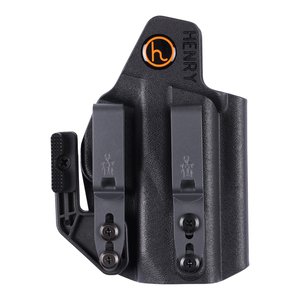
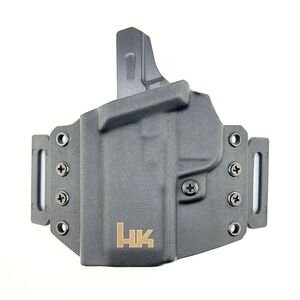
Shop CC9 IWB holsters
Concealment-first rigs. All molded specifically for the CC9.
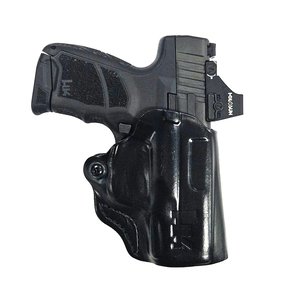
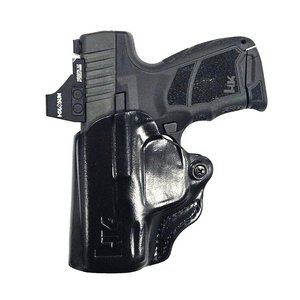
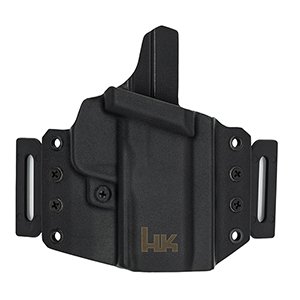
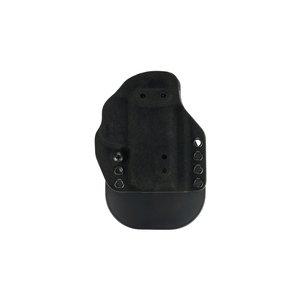
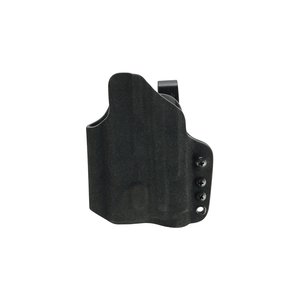
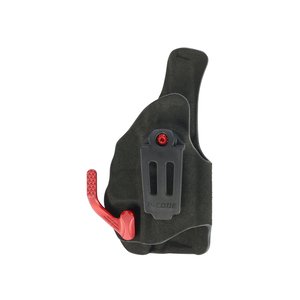
Shop CC9 OWB & belt holsters
Faster access and better comfort, for range use or carry under a cover garment.
CC9 magazine carriers
A spare magazine matters more on a micro-compact than on a full-size pistol, simply because the on-board capacity is lower. Both carriers below are molded for CC9 magazines.
Carry positions, and which CC9 rig suits each
Position matters as much as holster type. Here is how the common positions actually play out with a pistol the size of the CC9.
Appendix (AIWB) — roughly 1 o’clock
The holster sits forward of the hip, near the front of the waistband. The CC9 is close to an ideal appendix pistol because its short grip does not print through a shirt when you sit or lean forward. This is the fastest concealed draw available to most people, and the position keeps the pistol in front of you where it is hardest to take from you.
What to know: appendix carry demands a rigid, fully trigger-covering rig and a deliberate, slow re-holster every single time — the muzzle is pointed at your own body during that motion. Do not use a soft or collapsing holster here.
Suits: ANR Design IWB, Cipher Holster, DeSantis Slim-Tuk.
Strong-side hip — 3 to 4 o’clock
The classic position, directly on or just behind the dominant-side hip. More forgiving than appendix, more comfortable seated for many people, and it re-holsters with the muzzle pointed away from the body.
What to know: printing when you reach up or bend is the main concealment challenge. A holster that pulls the grip in tight to the body — a pancake design like the Mini-Scabbard — helps significantly.
Suits: DeSantis Mini-Scabbard, ANR Design OWB, DeSantis Inside Heat, G-Code Prime Carry.
Behind the hip — 5 o’clock
Conceals well under a short cover garment and stays out of the way when standing. The trade-off is a slower draw and real discomfort when seated for long periods, particularly while driving.
Suits: DeSantis Inside Heat, ANR Design IWB.
Fit, break-in and safety checks
Check these before you carry — unloaded, every time
- Trigger guard coverage. With the pistol seated, no part of the trigger or trigger guard opening should be reachable from any angle. This is non-negotiable.
- The inversion test. Seat the unloaded pistol, then turn the holster upside down and shake it firmly. The pistol should stay put. If it slides out, retention is inadequate — adjust it if the rig allows, or do not carry with it.
- Optic and sight clearance. If you run a red dot, confirm the optic does not contact the shell and that the pistol seats fully. Rubbing on the window will fog and scratch it over time.
- Re-holstering with one hand. You should be able to re-holster without using your support hand to hold the mouth open. A holster that collapses after the draw is a safety problem, not an inconvenience.
- Clip or loop security. Grab the grip and pull straight up hard. The holster should stay on the belt. A rig that comes out with the pistol during a draw is a serious failure.
Break-in expectations by material
Kydex (ANR Design, G-Code, Slim-Tuk shell) is essentially ready out of the box. Retention is set by hardware, not by wear, so it stays consistent for years. If it feels too tight, tighten or loosen the retention screws rather than forcing the fit.
Leather (DeSantis Mini-Scabbard, Inside Heat) needs a genuine break-in period. Expect the first week or two to feel stiff. The standard method: put the unloaded pistol in a plastic bag, seat it in the holster, and leave it overnight. Repeat until the draw smooths out. Never wet-form leather with the pistol inside — it can shrink unpredictably and lock up.
CC9 holster FAQ
Will a VP9 or P30 holster fit the CC9?
No. The CC9 is a micro-compact with a substantially smaller frame and slide than the VP9 or P30. A larger holster will not retain it safely — the pistol can shift, tip, or fall out. Use a holster molded specifically for the CC9. Every rig listed on this page is.
Do these holsters work with a red dot mounted?
The CC9 has a direct-mount optics cut, and holster makers have generally accounted for it on new CC9-specific molds. That said, optic clearance varies by footprint and by holster, so confirm compatibility on the individual product page or contact us with your specific optic before ordering. If you are running a taller enclosed-emitter optic, check before you buy rather than after.
What is the difference between IWB and OWB?
IWB (inside the waistband) sits between your body and your trousers so only the grip is exposed — better concealment, less comfort. OWB (outside the waistband) rides on the belt outside your trousers — more comfortable and faster to draw, but it needs a cover garment to stay concealed. Most people carrying daily start with IWB.
Which hand do I order if I carry appendix on my left side?
Order for your dominant shooting hand. A right-handed shooter carrying appendix orders a right-hand holster regardless of which side of the buckle it rides on. Carry position does not change the hand designation.
Do you carry left-hand CC9 holsters?
Yes — the DeSantis Mini-Scabbard LH, DeSantis Inside Heat LH, and ANR Design OWB LH. The DeSantis Slim-Tuk uses an ambidextrous shell and works for either hand. Our G-Code and Cipher CC9 rigs are currently right-hand only.
Is a more expensive holster actually safer?
Not inherently. Any correctly molded holster that fully covers the trigger guard and retains the pistol securely is safe to carry. Price buys durability, adjustability, and hardware quality — better clips, more mounting options, thicker material. A $56 Slim-Tuk that fits properly is safer than a $140 rig molded for the wrong pistol.
Can I tuck my shirt in over the holster?
Only with a tuckable design. Of the CC9 rigs we carry, the DeSantis Slim-Tuk is the tuckable option — its clip lets the shirt fall between the holster body and the belt. Standard IWB holsters will not accommodate a tucked shirt.
How long does leather take to break in?
Typically one to two weeks of regular use. Use the bagged-pistol method described above to speed it up. Kydex requires no break-in and can be carried the day it arrives.
Other CC9 gear we stock
If you are already ordering, these ship together.
Browse everything in Holsters, or see the full Accessories range.
About this guide
We wrote this because when the CC9 launched, buyers kept asking us the same three questions: will my old holster fit, do I need IWB or OWB, and which hand do I order. The guidance above reflects those conversations and the products we actually stock and ship.
What we sell and what we do not: we stock holsters, magazine carriers, cleaning gear, bags, apparel and accessories, all available to order directly on this site. We do not sell firearms or regulated firearm components here — product listings for those link out to the manufacturer’s own web shop.
Independence: this is an independent retail site. We are not affiliated with, endorsed by, or operated by Heckler & Koch GmbH or Heckler & Koch USA. Product names and model designations are used descriptively to identify fitment and remain the property of their respective owners.
Accuracy: prices and stock status shown here were accurate at the time of writing (August 2026) and are subject to change. The individual product page is always the authoritative source. Nothing on this page is legal advice — concealed carry laws differ by state and locality, and it is your responsibility to know the rules where you carry.
Carry a VP9 as well? See our HK VP9 holster guide covering the VP9, VP9SK, VP9CC and light-bearing rigs.
Questions on fitment? Browse the shop or get in touch before ordering — particularly if you are running an optic, a weapon light, or need a left-hand rig.